TLDR
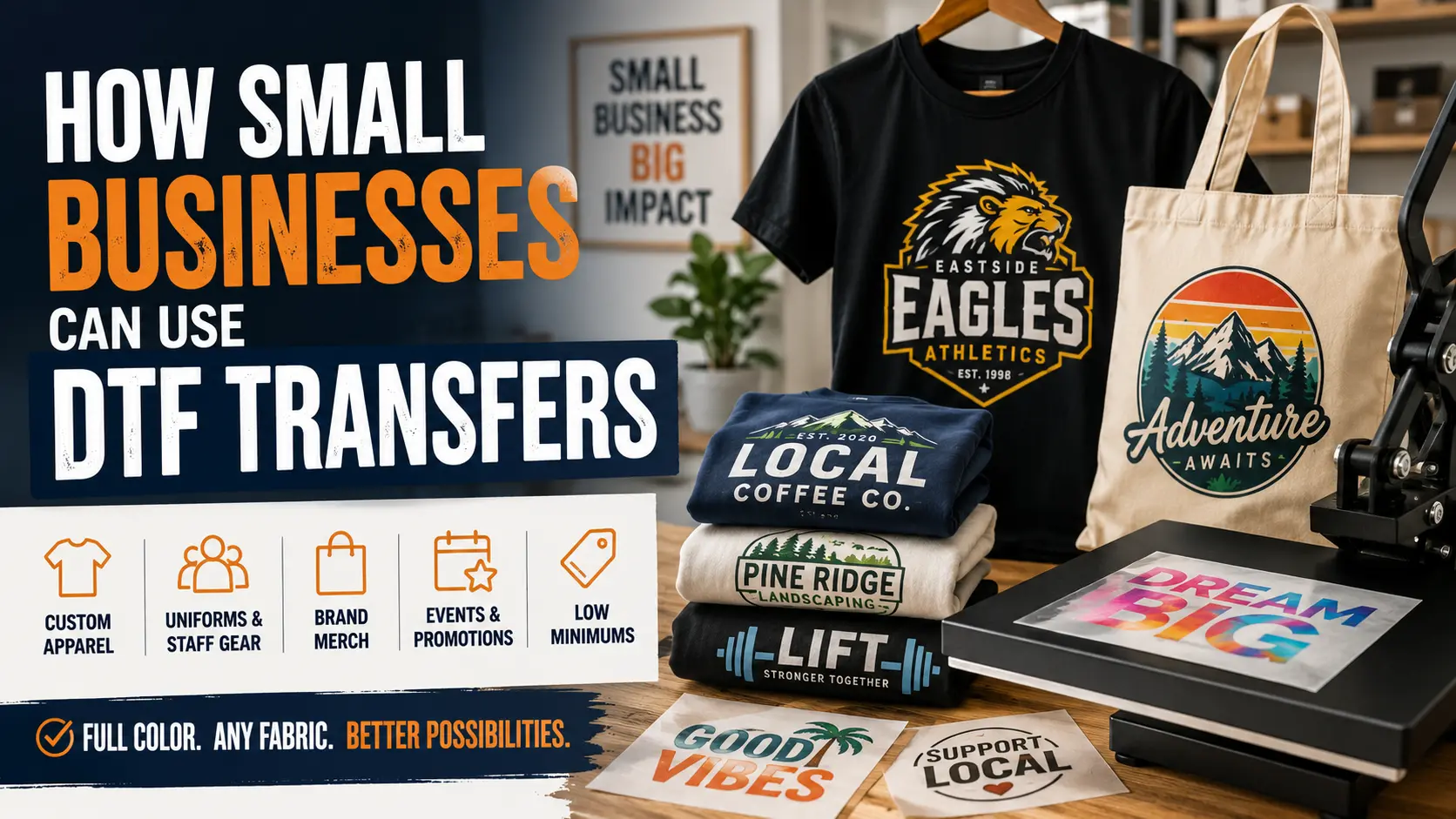
DTF transfers are full-color heat transfers that let small businesses make custom shirts, hoodies, tote bags, uniforms, and merch without buying a full print setup.
They are especially useful for small batches, event apparel, team gear, local brand merch, staff uniforms, creator drops, and testing designs before ordering larger quantities.
For most small businesses, the practical move is to order ready-to-press transfers, then apply them with a heat press. This keeps equipment costs lower and makes the process easier to manage.
Custom DTF transfers are a good fit for small business apparel projects because they are made for full-color artwork, detailed logos, light or dark garments, and flexible order quantities.
Why DTF Transfers Make Sense For Small Businesses
A small business does not always need 500 shirts. Sometimes it needs 12 staff shirts before a farmers market. Or 25 hoodies for a local event. Or five sample designs to see what customers actually want.
That is where DTF transfers are useful.
DTF stands for direct to film. A design is printed onto a special film, backed with adhesive, and then pressed onto fabric with heat. The finished transfer can go on shirts, hoodies, tote bags, uniforms, and other apparel. For small businesses, that means custom apparel without the old-school pressure of huge minimums, color limitations, and complicated setup.
The main advantage is flexibility. DTF transfers work well for full-color logos, detailed designs, gradients, small text, mascot art, and colorful merch. They can also work on cotton, polyester, and many fabric blends, which gives small businesses more room to test different products.
A coffee shop can make branded crew shirts. A gym can sell member hoodies. A food truck can create event shirts. A boutique can test a seasonal tote bag. A contractor can make cleaner-looking uniforms without ordering too much inventory.
That last part matters. Inventory is where small businesses get hurt. Ordering too many shirts in the wrong size, color, or design can tie up cash fast. DTF transfers let a business start smaller and learn from real demand.
What Are DTF Transfers?
DTF transfers are printed heat transfers for fabric. The artwork is printed onto transfer film, usually with a color layer and a white ink backing when needed. Adhesive powder is added to the print, cured, and then the transfer is pressed onto the garment.
The white ink layer is important. It helps the design stay bold on dark shirts, hoodies, and tote bags. Without that backing, bright artwork can lose contrast against black, navy, forest green, burgundy, or other dark fabrics.
DTF is different from screen printing, DTG printing, heat transfer vinyl, and sublimation.
| Method | Best For | Small Business Tradeoff |
|---|---|---|
| DTF transfers | Small batches, full-color designs, mixed garments | Needs good artwork and correct pressing |
| Screen printing | Large runs with simple designs | Setup can be less flexible for small batches |
| DTG printing | Soft prints on many cotton garments | More limited by garment type and pretreatment |
| Heat transfer vinyl | Names, numbers, simple shapes | Not ideal for detailed full-color art |
| Sublimation | Light polyester items and all-over designs | Not a universal shirt printing method |
DTF sits in a useful middle space. It gives small businesses full-color apparel without needing a separate screen for every color. It also avoids the cutting and weeding required with heat transfer vinyl.
Best Ways Small Businesses Can Use DTF Transfers
DTF transfers can support several parts of a small business: branding, operations, events, merch, employee apparel, and product testing. The best use depends on what the business needs right now.
Staff Shirts And Uniforms
Staff shirts are one of the simplest uses. A clean logo shirt makes a booth, shop, or service team look more organized. It also helps customers know who to ask for help.
DTF transfers work well for:
- left-chest logos
- full-front designs
- back prints
- sleeve logos
- employee name or role shirts
- event staff shirts
This is especially useful for businesses that do not need a huge apparel run. A small bakery might only need eight shirts. A cleaning company might need ten. A lawn care business might need a new batch every time it hires seasonal workers.
A good rule: keep staff designs simple. Use the logo, brand colors, and maybe a short line of text. Save the busy artwork for merch.
Branded Merch
Small businesses can also use DTF transfers to create merch that customers actually want to wear. This can work well for coffee shops, gyms, tattoo studios, salons, local bands, makers, breweries, boutiques, restaurants, and community brands.
Common merch ideas include:
- logo T-shirts
- seasonal hoodies
- tote bags
- limited event shirts
- slogan tees
- local pride apparel
- staff-favorite designs
- customer-requested designs
The key is to avoid making merch that only looks like an ad. The best small business merch usually feels like something a customer would choose even if they did not know the brand. Keep the design clean, wearable, and easy to understand.
For example, a pizza shop might sell a shirt with a simple illustrated slice and a short local phrase. A gym might make a hoodie with a small front logo and a bold back graphic. A bookstore might test tote bags with a reading-related design instead of only printing the store logo.
Event Apparel
DTF transfers are also useful for short-term events. Think farmers markets, 5K races, school fundraisers, grand openings, pop-ups, festivals, charity events, tournaments, and company parties.
Events often have awkward quantities. You may need 18 shirts, not 500. You may need three shirt colors. You may need one version for staff and another for volunteers. DTF transfers can make those smaller, mixed orders easier to plan.
For event apparel, focus on readability. A shirt may look great up close, but most people will see it from several feet away. Use strong contrast, clear text, and artwork that still makes sense at a quick glance.
Product Testing And Limited Drops
This may be the best small business use case: testing.
Instead of guessing which design will sell, order a small batch of transfers and press a few samples. Photograph them. Post them. Bring them to an event. Ask customers which one they would buy.
Then reorder the design that works.
This is useful for:
- creator merch
- seasonal drops
- local event apparel
- online store product testing
- boutique add-ons
- gym apparel
- band merch
- school club shirts
The goal is not to overthink every design. The goal is to reduce risk. A small batch tells you more than a mockup sitting on a screen.
How To Choose The Right DTF Transfer Size
The size of the transfer should match the placement. Bigger is not always better. A huge logo on the front of a shirt can feel stiff or awkward if the design does not need that much space.
Here is a simple guide:
| Placement | Common Use | Practical Size Direction |
|---|---|---|
| Left chest | Logo, staff shirt, uniform | Small and readable |
| Center chest | Brand mark, slogan, small artwork | Medium |
| Full front | Merch design, event shirt | Large |
| Full back | Staff shirt, sponsor layout, bold merch | Large |
| Sleeve | Small logo or text | Small |
| Tote bag | Logo or graphic | Medium to large |
CustomStickers.com offers DTF transfer sizes including 4″ x 4″, 6″ x 6″, 8″ x 8″, 10″ x 10″, 11″ x 11″, and 12″ x 12″. That gives small businesses room to order small logo transfers, larger shirt graphics, or full-front apparel designs from the same product page.
For most first orders, start with one or two practical placements. A left-chest logo and a full-back design is a common uniform setup. A full-front design is often better for customer merch.
What Artwork Works Best For DTF Transfers?
DTF transfers can handle detailed artwork, but the file still matters. A blurry logo will not become sharp because it is printed as a transfer. The cleaner the art, the better the finished garment.
Use high-resolution artwork at the final print size. For logos and text-heavy designs, vector files are ideal. For full-color artwork, a transparent PNG can work well because it avoids a white box around the design.
Before ordering, check for:
- transparent background
- clean edges
- readable text
- strong contrast
- correct final size
- no accidental white border
- no low-resolution screenshots
- no tiny details that disappear at shirt distance
Small text is possible, but it still needs to be readable. A shirt is not a business card. People view it from farther away, while it moves, wrinkles, and folds. When in doubt, simplify.
This is one of those practical design rules that saves money. The fewer surprises in the file, the better the finished apparel usually looks.
How Small Businesses Can Plan A DTF Apparel Project
A simple plan prevents most problems. You do not need a complicated production calendar, but you do need a few decisions before ordering.
Start with the job the apparel needs to do.
Is this for employees? Sellable merch? Event staff? A giveaway? A small online drop?
Then decide:
- Garment type: shirt, hoodie, tote, sweatshirt, or uniform item.
- Garment color: light, dark, neutral, bright, or mixed.
- Print placement: left chest, full front, back, sleeve, or tote front.
- Transfer size: based on placement and design.
- Quantity: samples, small batch, event run, or restock.
- Artwork file: clean, sized correctly, and ready for production.
- Pressing plan: heat press, correct pressure, correct timing, and garment care.
A heat press is the best tool for consistent DTF results. An iron may work in some cases, but it is harder to control pressure, temperature, and even contact. For customer-facing products or uniforms, consistency matters. A heat press is usually worth it if the business plans to make apparel regularly.
DTF Transfers For Local Marketing
DTF transfers can also support local marketing in a way that feels more useful than another stack of flyers.
A shirt can travel. A tote bag can show up at the grocery store. A hoodie can become a walking reminder of a brand, event, or local business. That does not mean every shirt needs a giant logo. Often, the better move is a design people actually like, with the brand worked in naturally.
Good local marketing uses include:
- giveaway shirts for loyal customers
- staff shirts for pop-up events
- tote bags for retail purchases
- fundraiser apparel
- branded hoodies for regulars
- local collaboration shirts
- limited shirts tied to a seasonal product
For example, a coffee shop could make a fall drink shirt. A gym could make a challenge hoodie. A landscaping company could make clean staff shirts and a few customer giveaway tees. A dog groomer could make tote bags with a simple pet illustration and a small logo.
The point is to make something people will keep.
Common Mistakes To Avoid
DTF transfers are approachable, but a few mistakes can make the finished apparel look less professional.
The first mistake is using poor artwork. Do not upload a small screenshot, blurry logo, or flattened design with a background box unless that is intentional.
The second mistake is choosing the wrong size. A design that looks balanced on screen may feel too large or too small on a real shirt. Print a paper mockup at size and hold it against the garment before ordering.
The third mistake is ignoring garment color. A design made for a white shirt may not work on a black hoodie without changes. Check contrast before production.
The fourth mistake is pressing inconsistently. DTF transfers need the right time, temperature, pressure, and peel method. Follow the instructions for the specific transfer. Guessing is where problems start.
The fifth mistake is using high heat during garment care. For longer-lasting prints, wash garments inside out, use cold water when possible, and avoid high heat in the dryer.
When To Order DTF Transfers Instead Of Printing In-House
Some apparel shops should own DTF equipment. Most small businesses do not need to start there.
A full DTF setup can involve a printer, white ink management, DTF film, adhesive powder, curing equipment, software, maintenance, testing, and wasted material while learning. That can make sense for a print shop or apparel business producing transfers every day.
For a bakery, gym, boutique, salon, school club, creator, contractor, or local event organizer, ready-to-press transfers are usually easier. You can focus on the artwork, garment choice, and customer demand instead of running print production yourself.
Order ready-to-press transfers when:
- you only need a small batch
- you want to test a design
- you do not want to buy DTF equipment
- you need full-color artwork
- you want transfers for mixed garment colors
- you want to press shirts yourself
- you need event apparel or team gear
Order DTF Transfers: https://customstickers.com/products/custom-dtf-transfers
Final Thoughts
DTF transfers give small businesses a cleaner way to make custom apparel without overcommitting. You can start with a small run, test real designs, make staff uniforms, create event shirts, sell merch, or build a simple local promotion around something customers can actually use.
The best projects start with a clear purpose. Staff shirts should be readable and consistent. Merch should be wearable. Event apparel should be easy to recognize. Test drops should stay small enough to learn from.
That is the real strength of DTF transfers for small businesses: they make custom apparel feel manageable. You can start with a design, a few garment choices, and a realistic batch size. Then you can adjust based on what customers, staff, or event attendees actually respond to.
FAQs
What Can Small Businesses Make With DTF Transfers?
Small businesses can use DTF transfers for custom shirts, hoodies, tote bags, staff uniforms, event apparel, merch drops, team gear, giveaways, and product samples.
Are DTF Transfers Good For Small Orders?
Yes. DTF transfers are a strong fit for small orders because they can handle full-color designs without the same setup demands as traditional screen printing.
Do I Need A Heat Press For DTF Transfers?
A heat press is the best option for clean and consistent results. An iron may work for some applications, but it is usually less consistent because pressure and temperature are harder to control.
What File Type Is Best For DTF Transfers?
A transparent PNG is commonly used for full-color artwork, while vector files are great for logos and text-heavy designs. The most important thing is that the artwork is clean, high resolution, and sized correctly.
Can DTF Transfers Go On Dark Shirts?
Yes. DTF transfers can work well on dark garments because the white ink backing helps the printed colors stay bold and visible.
Are DTF Transfers Better Than Screen Printing?
DTF transfers are often better for small batches, detailed artwork, and mixed garment types. Screen printing can still be better for large bulk runs with simple designs.
References
CustomStickers.com, Custom DTF Transfers product page: https://customstickers.com/products/custom-dtf-transfers
CustomStickers.com, Direct To Film T Shirt Transfers Guide: https://customstickers.com/community/blog/direct-to-film-t-shirt-transfers-what-they-are-and-when-to-use-them
CustomStickers.com, How To Make DTF Transfers For Custom Shirts: https://customstickers.com/community/blog/how-to-make-dtf-transfers-for-custom-shirts
Intent Sentence
This post helps small business owners decide how to use DTF transfers by explaining practical apparel uses, artwork setup, sizing, order planning, and tradeoffs, so they can create custom merch and uniforms with less risk.
SEO Pack
SEO Focus Keyphrase:
How small businesses can use DTF transfers
SEO Title:
How Small Businesses Can Use DTF Transfers
Meta Description:
How small businesses can use DTF transfers for shirts, merch, uniforms, events and low-risk product tests without buying print equipment in-house.
Slug:
small-business-dtf-transfers
Excerpt:
DTF transfers help small businesses create custom shirts, hoodies, totes, uniforms, event apparel, and merch without large minimums or full print equipment.
SEO Tags:
DTF transfers, custom DTF transfers, small business merch, custom apparel, heat press transfers, branded shirts, business uniforms
